
Enhancing Reading and Writing with the SAMR Model in the AI Era
*Disclosure* – I wrote this blog post myself with my idea of using the SAMR model to support understanding AI. I used AI to review it for me and clarify before I posted.
My goal here is to inspire other educators to use the SAMR to help plan for instruction that incorporates AI.
I teach future teachers in the Faculty of Education. I am always thinking about how to make assignments meaningful, and how to use AI to its fullest potential – not just for teacher candidates, but also to help them use AI with their students someday.
As educators, we’re continually searching for ways to integrate technology effectively, ensuring our teaching strategies not only engage students but also enhance their learning experiences. The SAMR model provides a fantastic framework for this integration. Lately, I have been thinking about Artificial Intelligence (AI), and how we can specifically use the SAMR model to harness for reading and writing instruction in the classroom.
It is beneficial to think about the SAMR model as a ladder, with each rung moving from using AI as a direct substituted for the teaching and learning strategies, moving up to augmentation, modification then using AI to redefine the learning.
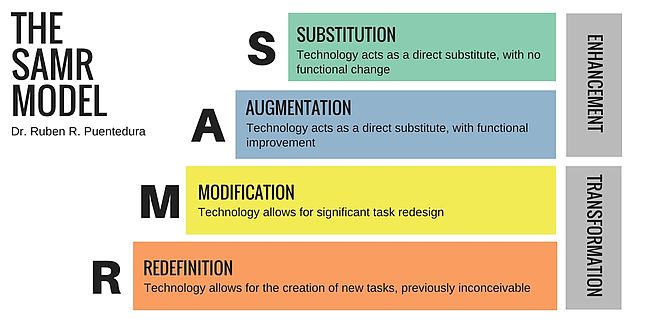
A visual of the SAMR Model
Let’s take a closer look at each step and how we can think about some actionable uses of AI.
- Substitution: AI as the New-Age Textbook
At the substitution level, AI can replace traditional resources without altering the educational task.- For example, in terms of Assistive Technologies, using AI-driven text-to-speech tools allows students to listen to readings instead of physically reading them. This tech swap introduces students to digital learning environments while maintaining familiar reading activities.
- Students can also engage in reading text on a screen just like they would on a piece of paper or a physical book.
- Augmentation: Enhancing Student Support
Augmentation takes the integration a step further by enhancing these basic tasks with AI’s capabilities.- In reading, AI tools can provide synonyms or explanations for complex texts, helping students grasp difficult concepts more quickly. Students can look up definitions of words they don’t understand, and listen to pronunciations of words.
- For writing, AI can offer real-time corrective feedback on grammar and usage, far beyond simple spell-check, thus enabling better writing practices and learning autonomy.
- When brainstorming and organizing thinking, AI can become a knowledgeable other for students when they have the right questions and prompts to begin to organize their thinking for a project.
- Modification: Collaborative and Creative Learning
At the modification stage, AI allows us to fundamentally change how students approach reading and writing. These AI-driven environments not only foster creativity but also encourage critical thinking and collaboration among students. - AI platforms can enable students to engage in collaborative story-writing, where AI suggestions help enhance story elements and plot development based on literary principles.
- Students can create new characters, or rewrite endings of stories
- Portfolios with reflections of readings can be developed.
- Redefinition: Breaking Boundaries with AI
Redefinition allows us to use AI to create entirely new tasks and learning experiences.- In reading, AI can analyze texts and generate interactive, immersive simulations where students explore the story’s setting or historical context in a virtual reality environment.
- For writing, AI can guide students to create complex narrative structures, create new characters, re-write endings of stories, or even co-write scripts for podcasts and videos, enabling a deeper engagement with the content and cultivating digital storytelling skills.
You can also hear from Dr. Ruben Puentedura, creator of the SAMR model, on how teachers can apply the model – from modification to redefinition – to transform teaching and learning.
By applying the SAMR model to AI use in education, we can enhance and transform how reading and writing are taught. This includes, but is not limited to, AI as an assistive technology tool. This approach not only makes learning more engaging and accessible but also prepares students for a future where digital and AI competencies are crucial.
In terms of assessment, AI can provide immediate, personalized, feedback. This has potential to ensure that more learning needs are met.
As educators, our goal is to equip students with the skills to succeed in an increasingly digital world, and integrating AI through the SAMR model is a powerful step in that direction.


 Big Ideas in Education
Please Leave a Reply